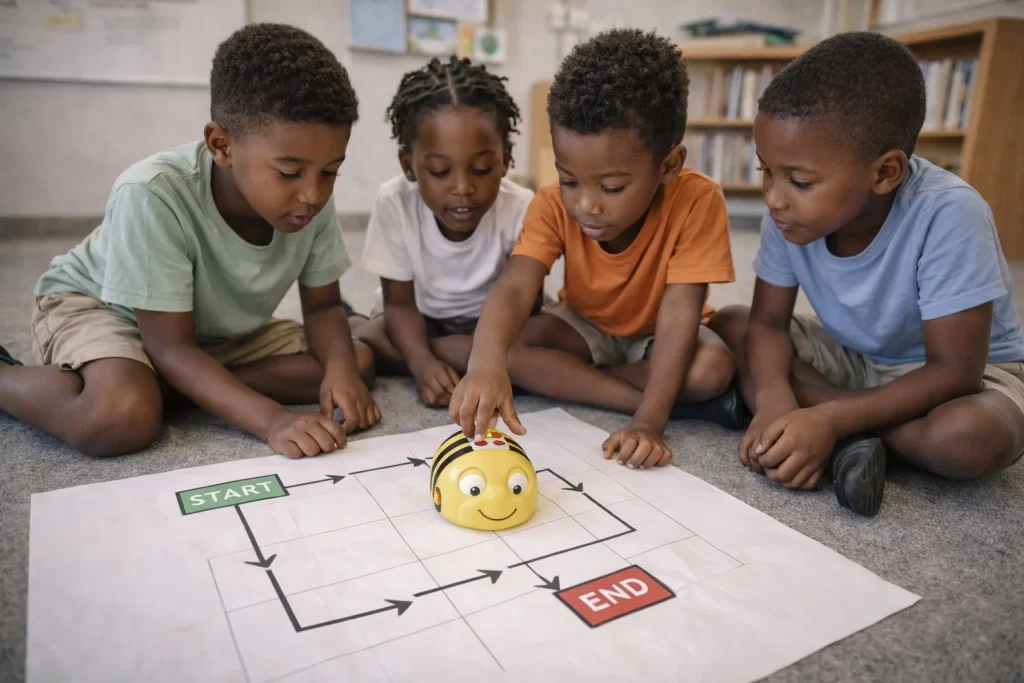
A group of young learners in Kampala just got their first introduction to AI, and they had a lot of questions.
Introduction
Are children in Uganda prepared to understand and use artificial intelligence responsibly?
For a group of learners aged six to ten at NCS Academy in Kampala, that question recently became a hands-on exploration. As part of the global Hour of AI initiative, a worldwide effort to introduce children to AI in an accessible, age-appropriate, and responsible way, NCS brought the Hour of AI learning into our classroom for the very first time.
Here is what happened.
Joining a Global Movement
The Hour of AI, developed through the global CSforAll network and supported by Code.org, invites educators around the world to introduce children to the fundamentals of artificial intelligence in a single, structured session.
The goal is not to produce AI engineers but rather to ensure that the next generation understands the technology that is already shaping their world.
For NCS, joining this initiative was a natural fit. We have always believed that children should not just use technology, they should understand it, question it, and eventually shape it.
The Hour of AI gave us the structure and the global community to take that belief into action.
Inside the Sessions
On the day of the sessions, seven learners between the ages of six and ten gathered at our Kampala centre. Some had heard the word 'AI' before, mostly from cartoons or things older siblings had mentioned. Few could explain what it actually meant.
True to NCS's hands-on teaching approach, the session was built around exploration rather than instruction. Learners were not given a lecture on artificial intelligence. Instead, they were given activities that let them discover what AI is, and what it is not, for themselves.
One activity asked learners to look at a series of images and decide how they would teach a computer to sort them. The room became immediately animated. Children debated loudly about which features mattered, changed their minds, and then watched with delight, and some confusion, when a simple AI model made a choice they did not expect.
"I thought computers always know the right answer," said one learner, a seven-year-old who had been one of the quietest in the group until that moment.
"But it made a mistake. So who teaches it?" That question, unprompted, from a seven-year-old, was exactly the kind of thinking the Hour of AI is designed to spark.
What the Learners Explored
Across the session, learners engaged with four core ideas that form the foundation of AI literacy:
- What AI isand what it is not. Learners discovered that AI is notmagic, not all-knowing, and not a single thing. It is a set of tools built on data and patterns.
- AI in everyday life. From music recommendations to voice assistants, childrenidentifiedAI they already interact with daily, often without realising it.
- How machines learn fromdata.Through simple sorting and pattern activities, learners began to understand how AI systems are trained and why the data fed into them matters enormously.
- Fairness, responsibility, and ethics. Age-appropriate conversations helped learners begin to think about who builds AI, whose experiences it reflects, and why fairness matters in the systems we create.
These are not easy ideas. But in the hands of curious six-to-ten-year-olds, they became genuinely exciting ones.
Why This Matters for Uganda
Artificial intelligence is not a distant, foreign technology. It is already embedded in the platforms, tools, and systems that Ugandan families, businesses, and institutions interact with every day and its role will only grow.
For young learners in Uganda, early exposure to AI concepts is about more than career preparation. It is about agency.
A child who understands how AI works is better equipped to question it, to recognise its limitations, and to participate in the conversations about how it should and should not be used.
The digital skills gap in Uganda is real. But it is not inevitable. Every session like this one is a step toward closing it, one curious learner at a time.
What Comes Next
The Hour of AI was a beginning, not a one-off event.
Building on what we saw in these sessions, the curiosity, the questions, and the willingness of young children to engage with complex ideas when they are made concrete, NCS Academy is developing a dedicated AI Literacy module to be integrated into our Academy programmes.
This module will sit alongside our existing coding, robotics, ICT, and digital creativity offerings, giving learners a structured, age-appropriate pathway through AI concepts from their earliest years at the Academy.
We are also exploring how AI literacy can be woven into our holiday camp programme, so that learners who join us for short-term intensive sessions have access to the same grounding.
The children who asked 'who teaches the computer?' deserve a full answer. We are building it.
Learn More
This activity was part of the global Hour of AI initiative, developed through CSforAll and supported by Code.org, which introduces learners worldwide to artificial intelligence in an engaging, accessible, and responsible way.
Learn more about the initiative:
- CSforALLHour of AI Initiative — https://csforall.org/en-US/hour-of-ai
- Code.org — https://code.org
Share This Article
Ready to Help Your Child Build Future-Ready Skills?
At Nestra Creative Studios, we help young learners move beyond simply using technology — to understanding, creating, and innovating with it.
Through coding, robotics, AI literacy, digital art, and ethical ICT education, we create hands-on learning experiences that prepare children for the opportunities of tomorrow.
- Coding & Programming
- Robotics & Engineering
- AI Literacy
- Digital Art & Creativity
- ICT & Computer Fundamentals
- Ethical Technology Education
It’s exciting to see children being introduced to AI concepts in such a practical, engaging, and age-appropriate way. Initiatives like this are helping prepare the next generation for a future driven by technology, creativity, and innovation. Well done 👍.
Great work NCS. You are indeed looking at the future.